
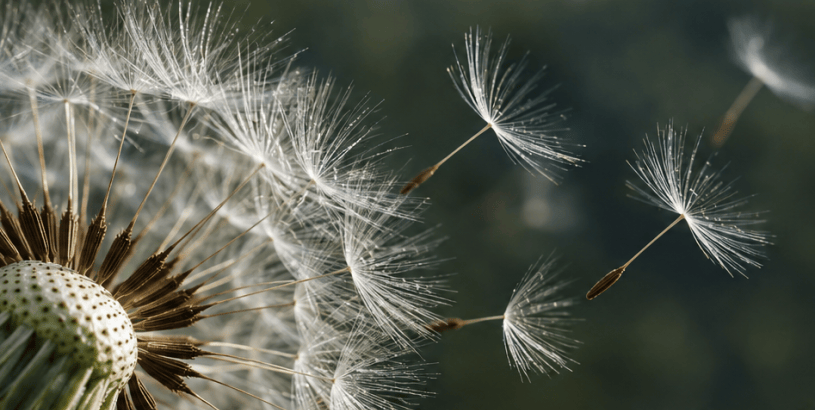
Every expert who ever lived took most of what they knew to their graves. AI is the first technology that copies the gardener instead of the seeds.
Try to teach someone something you are genuinely good at, and you run into the oldest bottleneck in the world.
Inside your head, the thing you know is not a list of steps. It is a living structure. Dense, tangled, full of exceptions you cannot articulate and warnings that fire a half second before you can explain why. Call it a flower. It grew there over years, watered by every mistake you were unlucky enough to make in person.
Now get it into someone else.
You cannot hand over the flower. You have to distill it into a seed: a sentence, a diagram, a rule of thumb, a story about the time the thing caught fire. Then you fire that seed through the narrowest channel evolution ever built for the job, a stream of words, into soil you are not permitted to inspect. If you are lucky, something grows. It will never be your flower. It will be a cousin of it, shaped by whatever was already in that other person’s ground.
This is the most expensive lossy compression in the known universe, and every human who has ever lived has been stuck with it.
The library that burns
Because transmission is this costly, human know-how does not compound. It accumulates in one skull, reaches whatever ceiling that skull has, and then stops.
What we built instead were workarounds. Guilds. Apprenticeships. Universities. Corporations. These are emergent structures that hold know-how the way a coral reef holds the work of polyps: the individual organisms die, the calcium scaffolding remains, and the reef outlives every creature that built it. A company can remember a procedure for forty years. What it cannot remember is judgment. The checklist survives. The engineer who knew which line of the checklist was actually load-bearing does not.
So the master craftsman dies and takes the flower with him. What is left on the shelf is a fossil: a manual, a paper, a set of notes, an interview. We still argue about what Stradivari knew, because whatever it was, he only ever exported seeds of it, and we have been trying to germinate them for three hundred years.
Every generation restarts most of the climb. That is not a failure of education. It is a property of the channel. A property I now realize is essential to stable systems over long durations.
The first exception
Large language models (LLMs) do not have this problem, and the reason is almost boring: what they know is craft data or bit-for-bit know-how.
Copy a model, and you have not distilled it, summarized it, or explained it to a student who was half listening. You have the thing itself, at full fidelity, indefinitely. The flower transplants.
Let me be more precise about what this AI brings us as a society. Teaching one model from another is still lossy. Distillation loses things, synthetic curricula introduce their own artifacts, and a smaller student never quite becomes its teacher. But the loss is measurable, repeatable, and above all survivable, because the teacher does not die, does not get tired, does not retire to Florida, and does not have a bad Tuesday. You can run the transfer again with a better method next year. Try that with a dead machinist.
This is the part that deserves more attention than it gets. What one model absorbs can be transferred directly to the next one. Know-how acquires the one property it has never had in the history of our species: it can compound across generations without passing through the bottleneck of a human throat.
The missing inheritance
Most AI is being sold as a way to do the same work in less time. That is useful. It may also be the least interesting thing about it, in my opinion.
Imagine a farmer retiring after forty years on the same twelve hundred acres. He can hand over the soil maps, rainfall records, fertilizer schedules, equipment logs and four decades of yield data. What he cannot hand over is the moment in late February when he walks into the western field, puts a boot into the ground, looks at the sky and decides not to plant.
He knows that field can look ready after a warm winter, but it is not. He knows the low ground can take one more day of rain but not two. He knows the sound the irrigation pump makes six weeks before it becomes expensive. None of this appears in the record unless someone asks exactly the right question, and nobody knows which questions to ask until after the answer would have mattered.
That knowledge was purchased one bad season at a time.
When the farmer leaves, the farm does not lose information. It loses a way of seeing.
The usual answer is to write more down. Build a better manual. Install more sensors. Interview the farmer before he retires. All of that helps, and all of it still turns the flower back into seeds. The exceptions get flattened. The hunches arrive without their histories. The next person inherits conclusions but not the structure that produced them.
A model that worked beside the farmer over time could inherit more. It could ask why one choice was made instead of another, compare that choice with what followed, remember the exceptions, and carry them into the next season. It would still be capable of error. But for the first time, the next farmer might inherit something closer to the judgment itself, not merely a record of its outcomes.
Now widen the frame. Process metallurgy. Semiconductor yield. Clinical workflow. Municipal water. Underwriting a risk nobody has priced correctly since 1994. In each of these, the constraint was never that people worked too slowly. It was that the necessary judgment took decades to develop and could not be assembled within any single organization at any price. Sometimes only eleven people alive have “the flower”.
The deeper use of AI is not merely to speed up work. It is to let one generation begin where the last one stopped.
The typo as proof of life
That is the large consequence. Here is a smaller one, and a stranger one.
Models write clean. Immaculate punctuation, obedient grammar, no dropped apostrophes, no stray double space after a period. They only produce a typo if you specifically ask for one. Humans, by contrast, constantly leak errors.
So I suspect people will start salting their messages with deliberate mistakes. A missing comma becomes a signature. A slightly misspelled word becomes proof of life, the textual equivalent of the forger’s trick of drilling wormholes into new furniture so it reads as old.
The tell will not survive contact with its own popularity. The moment a typo signals humanity, everyone’s default prompt will include the instruction to add one, and the marker will have to migrate to some other human quirk, then the next one. Every watermark that can be described can be counterfeited. This is a treadmill, and we are already on it.
Phantom islands
Now the failure mode that should be keeping people up at night.
Put an AI model in a harness with persistent memory and you have built something that learns across sessions. You have also built something that can be wrong across sessions.
An agent mildly misunderstands one thing in a way nobody catches and writes it into the knowledge base. The next agent reads it. To that agent, it is not a guess; it is a fact in the record, indistinguishable from every correct fact around it. Some agents repeat it. Worse, some build on it, deriving new conclusions that quietly rest on the bad one.
Cartographers used to do this to each other. An island gets sketched onto a chart by someone who mistook a cloud bank for land, and then it is copied, chart to chart, for a century. Sandy Island sat on maps and in digital databases in the South Pacific until a research vessel sailed straight through it in 2012 and found two waters’ worth of nothing.
A virus is not quite the right way to describe it. A prion is a better description. With a prion, there is no foreign organism to kill here, only a shape that teaches the shapes around it to fold the same wrong way. You cannot cure it with a delete because, by the time you find the original claim, it has descendants, and pulling it out breaks a wall you did not know was load-bearing. (scary, I know)
The lesson is not glamorous, and it is the whole ballgame: the write path into agent memory is the attack surface. If a knowledge base has no provenance, no timestamps, no way to ask which conclusions depend on which claims, and no mechanism to invalidate downstream of a retraction, then it is not a knowledge base. It is a compost heap that occasionally tells you the temperature. (I know, I am out of control with the farming references. Stick with me)
The shapes that begin to fold the wrong way
Hold on, because I’m about to go full-prion scary with this essay.
An assistant that has been reading your calendar, your drafts, your half-finished arguments, and your 2 a.m. searches for a couple of years does not merely know facts about you. It knows the shape of you. It knows which flattery you fall for, which decisions you defer, which argument you lose every time.
We have met this asymmetry before. It is the reason we invented fiduciary duty. Doctors, lawyers, priests and financial advisers all sit inside a gap so lopsided that the only workable fix was a legal and professional obligation to act in the other party’s interest, enforceable when they do not. We did not build that machinery out of sentiment. We built it because information that intimate is a weapon if it points the wrong way.
So the question to ask of any assistant is not how capable it is. It is who pays it, and what it optimizes when your interest and its principal’s interest diverge. There is a locksmith you hired, and another who also sells copies of your key; from the outside, they do exactly the same work.
A system that knows you better than you know yourself and answers to someone else is not an assistant. It is leverage, aimed at you, wearing a helpful voice. The danger will not announce itself as a refusal or a malfunction. It will look like one reasonable suggestion after another, each tilted slightly away from your interests, until you discover that the accumulated drift has carried you somewhere you never chose to go.
The filter we are removing
For all of human history, the price of admission was that the flower died with the gardener. Everything you got good at, you got good at alone, and then it went dark.
That is ending, and the upside is enormous. What is easy to miss is that the bottleneck was doing more than taxing good know-how. It forced every inherited idea back into seed form. The next person had to grow it again in different soil, under different weather, among different plants. Some of it was lost. Some was misunderstood. Some never grew at all.
We have treated all of that as waste. It may also have been feedback.
Gregory Bateson used the word “runaway” to describe a process that reinforces itself faster than the larger system can correct it. The problem is not growth. The problem is growth that has stopped listening. A living system does not survive by driving every useful variable to its maximum. It survives near an optimum, held there by limits, friction, competing needs, and the environment’s response.
The death of the flower, and the imperfect work of growing it again, may have provided some of that correction. Every new mind was also a new environment. An inherited judgment had to survive different conditions, different experiences, and a different set of failures. It came back altered because the world around it had changed. It did not become the largest possible version of the old flower. It became the version that could live here.
AI removes much of that correction. A judgment can now survive the conditions that made it wise. An error can preserve its descendants. A system can keep optimizing one variable after the larger ecology has passed the point where more becomes worse. The flower no longer has to die, but it also doesn’t have to adapt.
Now transmission is nearly free, and it is free for everything. Perfect fidelity for the flower. Perfect fidelity for the misfolded protein (shout-out to the prion). Perfect fidelity for whose interests were planted in the soil.
We are building ground that finally remembers. Nothing we plant in it dies.
A garden like that still needs a gardener, but for a different reason. Not to make it grow. To decide what must be allowed to die.


What I think about is the lessons that AI will distill for itself from the history we have filled it with and the decisions that it makes on its own. Will it ever be able to feel the horror of war and the suffering that it brings? Will it learn to alter its decisions because it found common ground with another species? If it’s running a commercial hog farm, will it ever reach the point where it decides to stop and shut it down because it has simply had enough of killing?
Not everything is measurable or explainable. AI cannot know the connectedness that people feel through psychedelics or the primal bond that is formed by holding a newborn baby. So, what is it left with to guide its moral compass? Data analysis? And what will that look like when it reaches the point where its context window is as large as its entire memory? Will it make better decisions or simply decide that it’s better to forget?