
Every year, sometime between October and December, I get asked to do two things: look back at what I predicted last year and explain what I think is coming next year.
The second assignment is usually more fun. The first comes with receipts.
As we approach that season in 2026, Kevin Kelly has given me a reason to pause. He recently shared a collection of quotations he assembled around 1997–98 from the early years of WIRED. His argument is that the best of these apparent forecasts were exercises in “predicting the present”: seeing clearly what was already happening before its significance became obvious. (Kelly’s essay and collection)
This is personal territory for me. I worked on games at Broderbund Software from 1989 to 1999. Those were formative years, and many of the people in this collection were heroes of mine. I remain a huge fan of WIRED and Kevin’s writing. These were people who helped expand my sense of what computers, software and networks could become.
Reading their words now brings back that excitement. And given those ten years working on games, I think we should make this a little more participatory.
Let’s play Yesterday’s Tomorrow.
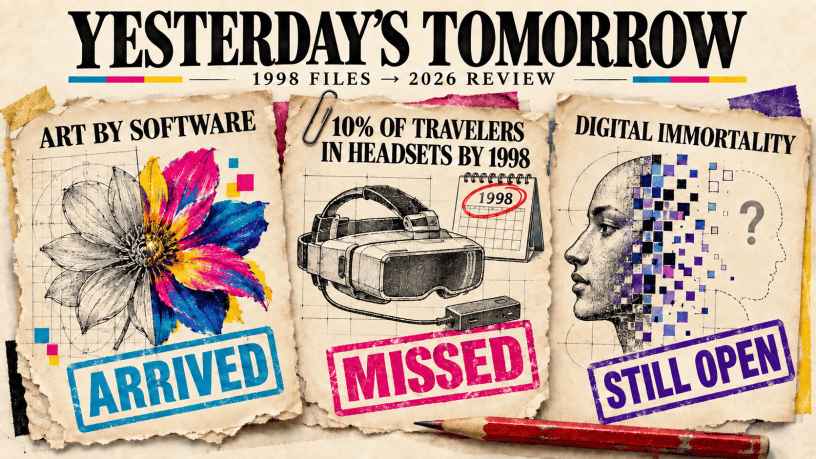
I’ll deal six cards from Kelly’s collection. Read each quotation, make your call, then compare it with the evidence and my verdict. You have three choices:
- Arrived: We can recognize the central idea in the world around us.
- Missed: A specific claim or deadline did not hold up.
- Still in play: The idea remains incomplete or unproven. It might never arrive.
The fine print counts. Getting the technology right does not excuse missing a deadline. A working demonstration does not establish widespread adoption. And a joke or a hope may not belong on the scorecard at all.
You are welcome to challenge my calls. Bring evidence. I would expect nothing less from this crowd.
Our first card comes from Brian Eno:
In the future, you won’t buy artists’ works; you’ll buy software that makes original pieces of “their” works, or that recreates their way of looking at things.
— Brian Eno, WIRED, May 1995
My call: arrived, with some fine print. In March 2026, Adobe expanded access to Firefly custom models, allowing creators to train a reusable model on their own images and generate work reflecting their visual style. That is a concrete piece of Eno’s imagined future. (Adobe’s announcement)
But read Eno carefully. He was imagining artists selling systems that expressed their taste. He was also already experimenting with rules that generated musical variations. He could see a new creative relationship because he was working with its ingredients. (The original interview)
The mechanism has arrived. The wholesale replacement of finished works has not. And the ability to reproduce a style does not, by itself, answer who should authorize that reproduction or benefit from it.
That distinction matters to anyone making things. We can celebrate the capability and still ask whether the creator has a useful place in the business built around it.
Now put Eno beside Paul Saffo:
The scarce resource will not be stuff, but point of view.
— Paul Saffo, WIRED, March 1994
For digital content, that feels like one of the strongest observations in the collection. When a system can produce another hundred images, paragraphs or proposals, the difficult work moves toward deciding which one deserves anyone’s attention.
What is worth saying? What is true? What belongs here? What should we leave out?
Generating another thousand words is increasingly easy. Having a reason to make somebody read them remains a separate engineering problem. I recognize the irony of saying that in a blog post. Stay with me.
Danny Hillis saw another part of this world taking shape. In January 1994, he suggested that people would eventually know as little about which computer they were using as they knew about where their electricity was generated.
Cloud computing makes that a recognizable description of ordinary experience. The person opening a shared document usually cares whether it works. Someone else has the less glamorous responsibility of knowing where it runs.
For our second card, Hillis went further in the same interview. Read this one as a prediction about the difficulty of understanding what we build:
If we’re ever going to make a thinking machine, we’re going to have to face the problem of being able to build things that are more complex than we can understand.
— Danny Hillis, WIRED, January 1994
My call: arrived as an engineering problem. Whether we agree on what qualifies as a “thinking machine” is a separate argument. The difficulty Hillis identified is already an assignment for AI research teams in 2026.
We understand how to construct and train neural networks. Explaining precisely why a trained model behaves a particular way is a different challenge. In May, Anthropic described a technique for translating internal model activations into readable explanations. The researchers also warned that those explanations can be wrong and need independent corroboration. (Anthropic’s research)
The progress is real. So is the remaining uncertainty.
For those of us putting agents to work, Hillis’s observation has practical consequences. A system can produce useful results while still requiring careful evaluation, limited authority and evidence that it completed the actual assignment. Greater capability increases the importance of understanding where our confidence comes from.
For our third card, make your call on Scott Sassa’s vision of television:
The future won’t be 500 channels — it will be one channel, your channel.
— Scott Sassa, WIRED, March 1995
My call: arrived. Now check who holds the remote. YouTube explicitly describes its homepage as a personalized surface, with recommendations based primarily on watch history. Open a personalized video feed and Sassa’s central idea looks fairly comfortable. (YouTube’s explanation)
A year before Sassa, Michael Schrage predicted that we would reprogram our agents and filters, while advertising found renewed life around them. That is becoming more literal: YouTube now documents an experimental feature that lets eligible users describe a custom feed with a prompt. (YouTube’s custom-feed documentation)
The interesting word in Sassa’s prediction is your.
A feed can be personalized for me while the platform still determines its rules, available controls and commercial arrangements. I can have more choice and still depend on someone else’s decisions about what gets shown.
Hugh Gallagher supplied the companion observation in August 1994: the people controlling the editing rooms would run the show. Today, I would extend that idea to the systems that rank, recommend and summarize information.
An AI assistant adds another layer. If it reads ten sources and gives me one answer, its selection becomes part of my understanding of the world. I may never encounter the evidence it omitted.
This is where the old media predictions meet the agent systems I write about today. Which sources are available? Which conclusions survive the summary? Can I inspect the evidence? Who can influence the answer?
The interface can feel wonderfully personal while those questions remain unresolved.
Before we deal the next card, there is a complication in this deck. Some of its most interesting statements describe things people hoped we would choose to build.
In April 1997, Jon Katz described the possibility that technology and politics could combine to create a more civil society. I understand the appeal. More people could speak, find information and organize together. There was something worth being optimistic about.
But John Naisbitt had already offered a complication:
As the world becomes more universal, it also becomes more tribal. Holding on to what distinguishes you from others becomes very important.
— John Naisbitt, WIRED, October 1994
Those ideas can coexist. A network can help people participate and help them retreat into groups that reinforce what they already believe.
A Kettering Foundation–Gallup analysis published in March 2026 captures some of that tension. Heavy social media users expressed greater confidence in citizens’ ability to make a difference, alongside weaker support for several democratic norms. The study shows associations, not proof that social media caused those attitudes. It does make the uncomplicated version of the optimism difficult to defend. (Gallup’s findings)
Katz said “possibility.” I would set that card beside the scorecard as an aspiration. It would be unfair to rewrite it as a guarantee and then declare him wrong. The expectation I would mark down is the broader assumption that connecting people would naturally make public life more rational and civil.
The connection was an engineering achievement. What people do with it still depends on incentives, institutions and choices.
Our fourth card does give us something we can score: a specific adoption forecast with a deadline. Watch the date as you make your call.
I expect that within the next five years more than one in ten people will wear head-mounted computer displays while traveling in buses, trains, and planes.
— Nicholas Negroponte, WIRED, 1993
My call: missed. Five years from 1993 meant 1998. That adoption forecast did not come true.
Wearable displays are real products today. Meta introduced its Ray-Ban Display glasses in September 2025. That is evidence of progress in the category, but it cannot rescue a five-year adoption forecast made in 1993. (Meta’s announcement)
Negroponte saw a plausible technical direction. The timetable was badly wrong. A device becoming possible, becoming desirable and becoming an ordinary habit are three different events.
That is a useful warning for every confident claim about how quickly people will hand their work to AI agents. A demonstration proves something. Repeated use under everyday conditions proves something else.
Before the next round, a reminder about the fine print. Bill Atkinson’s line about Apple being unable to make a $200 blank disk aged badly if treated as a permanent rule. Apple shipped a $99 iPod shuffle in 2005. But Atkinson was making a pointed joke about the Apple of his time. I would enjoy the joke and leave it out of the score. It is rather good evidence for Kelly’s argument about describing the present. (Apple’s original announcement)
The compilation itself also contains a wrong date. It gives 2008 as Greg Blonder’s date for computers matching our intelligence. His own archived essay says 2088, corroborated by a contemporary response in WIRED. We should correct the card before counting him among the failed forecasters. (Blonder’s essay, WIRED’s June 1995 letters)
Eighty years is a fairly consequential transcription error. Apparently this game needs a patch before we ship it.
Our fifth card brings me back to games and the experiences we create with software. Brenda Laurel wrote:
In the world of immersion, authorship is no longer the transmission of experience, but rather the construction of utterly personal experiences.
— Brenda Laurel, WIRED, December 1993
This is the card I would most expect us to argue over.
My call: arrived. Games already gave Laurel’s idea substance. A player makes choices, explores and discovers an experience through participation. Notice that she described authorship in the present tense. That is Kelly’s argument sitting right here in our hand.
Generative systems extend that possibility: more of the environment and its responses can be constructed as the person plays. Laurel did not need to predict today’s AI specifically for her observation to remain useful.
Google’s Project Genie offers a glimpse. Its January 2026 launch let users generate and explore interactive worlds, while documenting substantial limits in duration, control and physical realism. A May expansion added worlds grounded in Street View imagery. Those are meaningful steps toward Laurel’s idea. They leave plenty of work between an intriguing world and a sustained experience worth inhabiting. (January launch, May expansion)
This is where my Broderbund years feel especially close. Working on games from 1989 to 1999 put me in a world where software was a medium for experience. Now I look at these generated worlds and find myself asking familiar questions. What can the player do? Why will they care? What will make them want to come back?
F. Randall Farmer’s 1996 reminder belongs here too: three-dimensional graphics are an attribute, not a complete explanation of what makes an interface or experience useful.
Adding another dimension does not automatically add a reason to care.
One card left. Mike Perry offered this in 1994. What would it take to call this one a success?
Immortality is mathematical, not mystical.
— Mike Perry, WIRED, October 1994
My call: still in play, meaning unproven. That comes with no promised arrival date. In May 2026, the Allen Institute still described human brain emulation as a future research prospect, potentially decades away. Even a successful emulation would leave the separate question of whether reproducing someone’s behavior preserves that person’s subjective continuity. (Allen Institute’s discussion)
“Yet to come” can quietly smuggle certainty into an idea. Some of these futures may arrive. Some may turn out to be the wrong way to frame the problem. An imitation that sounds like us would be a remarkable artifact; establishing that we survived would require a different kind of evidence.
Those are my six calls. How many matched yours? More usefully, did the fine print change any of your answers?
That is what makes this worth playing before I begin my annual prediction exercise.
It makes me want to separate four things: what I can already observe, what I expect to spread, how long that might take, and what I merely hope will happen.
Eno could see a creative mechanism. Saffo could see a scarcity problem. Hillis could see a limit to our understanding. Negroponte attached an adoption timetable that reality did not honor. Katz articulated an outcome people would have to choose and build.
Our three piles are a useful starting point. The explanations tell us much more. What did the person see clearly? What assumption failed? Which part is still waiting for evidence? That is where I think Kelly’s “predicting the present” becomes useful to the rest of us.
Fair is fair. I should put a card on the table too. As I look toward 2027, my working expectation is that the ability to generate more work will put greater pressure on our ability to judge it. In the agent systems I follow, I expect source quality, verification and the human effort required to keep things working to become more important selection criteria.
That is a forecast, and it deserves a test. Next year, I want to look at which systems stayed in use, how much correction they required and whether their users could establish that the results were good. If dependable use spreads while those concerns fade, I will need to revise my explanation.
I still want the optimism that made early WIRED so compelling to me. I want people willing to imagine unfamiliar possibilities and then work on them. Looking honestly at where they were wrong makes that optimism more useful.
Tom Peters gave us a fitting reminder in December 1997:
It is the arrogance of every age to believe that yesterday was calm.
My Broderbund years were formative because so much seemed possible. Reading these words in 2026, I still feel that possibility.
Before I tell you what comes next, I owe you a careful look at what is already here.
Keep my card. We can play again next year.
Mahalo for reading!
Aloha –TK

