
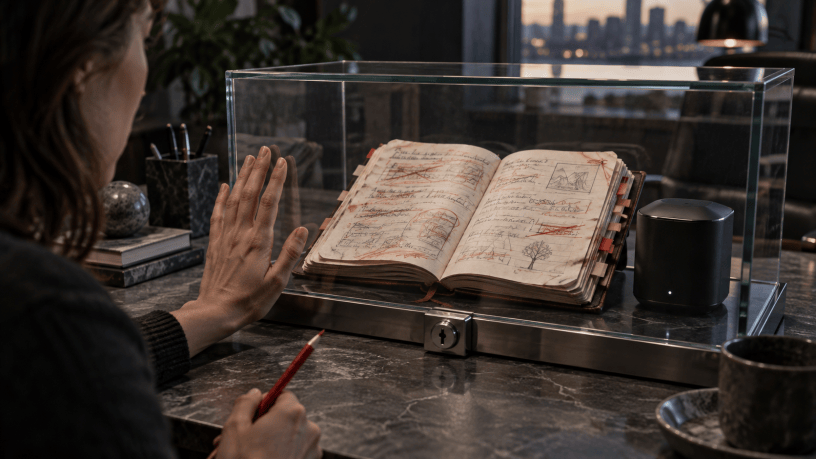
Your next AI assistant may be much more capable than today’s.
It may also need you to explain, again, how you work.
Why you rejected that argument. What makes a design feel right. When brevity becomes oversimplification. Which reasonable-looking shortcuts violate something you care about.
The model improves. Your working relationship starts over.
We should expect more from progress. Every correction makes the assistant more useful. Does it also build something we control?
I think we should plan as though today’s AI will be among the least capable we use this decade. Individual releases will disappoint, and improvement will vary by task. But building our working lives around one model’s limitations is a poor long-term bet.
Imagine changing jobs a few times in ten years while encountering a hundred model revisions and several assistants each year. That is a planning scenario, not a forecast. The technology could change much faster than your professional identity.
What carries your experience across those changes?
Alfred Korzybski offered a useful starting point a century ago. He and I share a minimalist approach to hairstyling. His contribution here is considerably more substantial.
In Manhood of Humanity, published in 1921, he described humans as a time-binding class of life. We accumulate knowledge, preserve achievements, and pass them forward so subsequent generations can build on them. He treated this as a defining human distinction. Manhood of Humanity
An apprentice inherits techniques they did not invent. An engineer builds on discoveries made before they were born.
The contribution survives the contributor.
Korzybski also gave us one of my most useful reminders: “The map is not the territory.” In Science and Sanity, he distinguishes a representation from what it represents. Excerpt from Science and Sanity
My understanding of something is an abstraction. However useful, it remains my map of reality. Reality is under no obligation to follow it.
These ideas belong together.
Time-binding asks what understanding can carry forward. The map-and-territory distinction reminds us that what we preserve remains incomplete and subject to correction.
A bot’s memory of you is a map. You are the territory.
I believe we need a form of time-binding in the bots working alongside us. This extends Korzybski’s idea; it does not claim he anticipated AI assistants.
Each generation of assistant should inherit useful lessons from its predecessor. Our corrections, discoveries, and evolving standards should survive a change of software.
Consider working with a bot on an article.
You ask for something provocative. It produces an alarming headline with a weak argument. You explain that provocation should come from exposing an overlooked consequence, not exaggerating a threat.
After several drafts, it gets the distinction.
The finished article is valuable. So is the lesson that produced it.
If the next assistant receives only the article, it may imitate your sentence lengths and miss your judgment. The rejected opening, your explanation, and the accepted revision offer better evidence of what you consider good work.
A useful inheritance preserves something of how we arrived at the result.
This matters as capability changes.
You explain a task differently to an intern than to a master of the craft. The intern may need steps. The master needs the purpose, constraints, and context to exercise judgment.
Perhaps you once required a bot to show every intermediate step because it repeatedly misunderstood assignments. That procedure may become unnecessary. The underlying requirement—make consequential assumptions visible—still matters.
Preserving every workaround could make tomorrow’s assistants behave like yesterday’s. We need to preserve our standards while allowing the method to improve.
For me, that inheritance has three parts.
Examples that reveal taste.
“Write in my voice” says little. A strong opening beside a rejected one, with an explanation of the difference, gives an assistant something to work with.
The same applies to design, research, and decisions. Preserve what you chose and why, including the tradeoffs. Taste becomes more useful to a collaborator when it has evidence behind it.
Principles that survive changing tools.
You may value intellectual honesty over a tidy conclusion, prefer a reversible experiment to a confident prediction, or want disagreement before a decision becomes expensive.
Those preferences can remain relevant across jobs, models, and applications. They should also remain open to examination. A good assistant should help you recognize when a familiar preference produces a poor result.
Lessons that can be corrected.
Perhaps an assistant concludes that you dislike detailed explanations because you requested a short answer during a busy afternoon.
It records “prefers brief answers.” The next assistant inherits that note. A temporary circumstance becomes an enduring claim about who you are.
The map has acquired a road that was never there.
A useful record distinguishes your instructions from the assistant’s guesses and preserves relevant context. “Requested a brief answer before a meeting” differs from “does not want detailed analysis.”
Time-binding can carry mistakes forward too. We need to improve the map as we pass it along.
This brings us back to control.
If those lessons exist only inside one provider’s memory system, that provider holds part of your investment in becoming effective with the assistant.
Leaving means paying some of that cost again.
A competing bot might be more capable, trustworthy, or suitable. You may still stay because the current one knows how you work.
Dependence can grow through successful service, without anyone deliberately making departure difficult.
The Data Transfer Initiative advocates transferring personal data, including information used to customize a service’s behavior, in structured, documented formats. The practical question is whether the next assistant can use what arrives. DTI’s AI portability principles
For users of Dots, Muse, Grok Bot, or whatever comes next, I would start with a small collection you control independently.
Keep representative work, important decisions and their reasons, explicit preferences, and reviewed lessons. Use readable formats. Identify what is current, project-specific, or superseded.
The bot can help maintain it. You should be able to inspect and correct it.
Different assistants need different portions. A writing assistant may need your editorial standards; a scheduler probably does not need private drafts. Your working preferences may travel between jobs; an employer’s confidential information does not automatically travel with them.
Then try one modest transfer.
Give another assistant relevant material and a fresh task. Does it recognize a distinction you previously taught? Can it apply the principle in a new situation? Does it question an inherited instruction that no longer fits?
The next collaboration should begin further along.
A more capable assistant may challenge your favorite example or offer a better method. Preserving your judgment should not mean freezing it.
Our assistants should become easier to replace because they have helped us accumulate something worth keeping. Otherwise, every correction strengthens our dependence on the place where it happened.
The model will change. The bot may change. You will change.
Carry the useful maps forward. Keep checking them against the territory.
Every correction, rejected draft, and explanation of what matters is an investment. Those lessons should help your next assistant begin further along.
You taught your bot. You should be able to take the lessons with you.
Mahalo for reading!
Aloha –TK

