
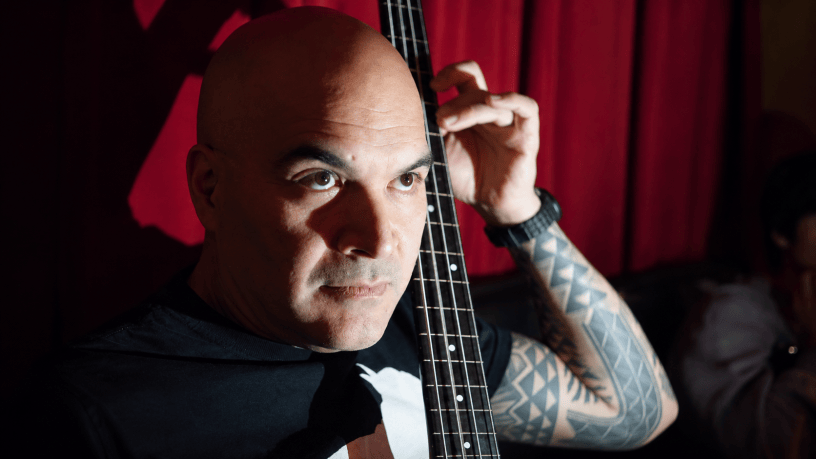
What playing in bands taught me about building with AI
Long before I knew what a computer was going to mean to me, I was pretty certain what I was going to do with my life.
I was going to be a musician.
The first requirement for becoming a musician is access to an instrument. For me, that came through church. There were guitars, basses and ukuleles around, and by the time I was eight years old I could play all of them reasonably well.
Then I got lucky again.
In fourth grade I attended an elementary school where music was treated like a real subject, right alongside science, history and mathematics. I chose the double bass. Two years later, in sixth grade, I auditioned for the Honolulu Youth Symphony and made it.
By then I could read music. I had been through ear training. Music was becoming less like something I did and more like the way I processed the world.
My parents could see that I was serious.
One year they took their entire tax refund, walked me into a music store and tried to buy me a Fender Precision Bass. This was the 1970s, and I was about eleven years old.
There was one problem. With tax, the bass cost more than my parents had.
The salesman could have let us walk out empty-handed. Instead, he looked at me and asked, “Son, can you read music?”
I said yes.
He looked at my father and told him he would discount the bass on one condition. Two local high school stage bands were missing a bass player. If I would play in them, he would make the deal work.
So for the next year or so, my father drove his eleven-year-old son to Roosevelt and McKinley High Schools to play with a bunch of scary high school kids.
Some of them were even nice.
By fifteen I was playing professionally in Waikiki. The drinking age was eighteen, but I looked older. I kept my mouth shut, played my bass, took the money and went home.
For much of ninth and tenth grade, I would play in nightclubs until one in the morning, sometimes four, go home, do whatever homework I could, struggle through school, sleep for a few hours and then go back to work.
By eleventh grade I was burned out.
I sat my parents down and told them I wanted to drop out, take my GED and play music full time. I was already making enough money to support myself. If it didn’t work, I told them, I could always go back.
As they had so many times before, they supported me with love, trust and probably a lot more courage than I appreciated at the time.
I went on to travel, play with small and large acts, open for people whose names everyone would recognize, and even appear in an MTV video.
I was certain I had found the thing I would do for the rest of my life.
I was wrong.
But I wasn’t nearly as wrong as I thought.
What I learned playing in bands turned out to shape almost everything I did afterward.
A good musician has to understand two things at the same time. You have to know exactly what is expected of you, and you have to understand enough about everyone else’s role to know how your part fits into the whole.
Experience on an instrument doesn’t guarantee that someone will be a good member of a band.
Not everyone needs to write the song.
Writing the song doesn’t mean anyone will like it.
And it certainly doesn’t mean anyone will pay for it.
Every role matters, but distribution matters too. Five musicians playing five different roles can make a band. Five bass players mostly make a problem.
The best musicians also understand restraint.
A great bass player hears the entire song. Every note played, and every note not played, is intentional. You’re not graded on the quantity of notes you play. You are helping tell a larger story.
The same is true of every good player I’ve worked with. The ones who are there mostly for themselves find every open space and fill it. They may be technically brilliant, but they’re playing for themselves instead of the audience.
Usually you try to steer them back toward the song.
If that doesn’t work, they probably need a solo gig.
The best bands also require trust.
Music happens in real time. You have to trust that the drummer will be where you expect them to be. They have to trust that you will be there too. You need enough confidence in the people around you to take a creative chance without worrying that the entire thing will collapse.
The best bands I ever played in were the ones where I felt safe, cared for and able to do my best work.
Forty years later, I’m still in touch with people from some of those bands.
That probably tells you something.
It also turns out that musicians have been living with technological disruption for a long time.
I am brutally critical of drummers. I know what a great drummer feels like within the first few seconds. Meter and feel are established almost immediately, and for me the judgment is close to binary.
Then drum machines showed up.
In 1982 I sold my car and spent around $3,000 on a LinnDrum.
That was an enormous amount of money for me, but I thought it was a critical pivot.
We were playing Top 40 music in Waikiki hotels, and more and more of the records we were covering were themselves being made with drum machines.
We could open a set with something like “Relax” by Frankie Goes to Hollywood, kick off that machine, and people would immediately move toward the dance floor.
I knew what done sounded like.
And now I had a machine that could produce that part of the outcome with extraordinary consistency.
So I fired the drummer.
That sounds harsh when I write it today, but I wasn’t thinking about automation or the future of work. I was thinking about the band and the audience. I knew what the role required, and I had found a better way to get that result.
I have also been on the other side of that equation.
I’ve sat in recording studios and had producers tell me, “What you’re playing is absolutely not working.”
I’ve had them ask why I played something and tell me to try something else.
I’ve also been told that my electric bass part was being removed entirely and replaced with a sequenced synthesizer.
The song did not owe me a bass part.
That lesson stayed with me.
People like George Martin and Rick Rubin are useful examples of what a great producer can contribute. Their value isn’t that they necessarily play every instrument better than the musicians in the room.
They know what the finished thing is supposed to become.
They can hear when something is moving toward that outcome and when it isn’t.
Take that out.
Try this.
That’s technically impressive, but it isn’t helping.
That’s it.
If you have ever worked with a great producer, those directions probably sound familiar.
By the mid-1980s, computers had already started finding their way into my musical life. I bought a Macintosh 512K and began figuring out what this new instrument could do.
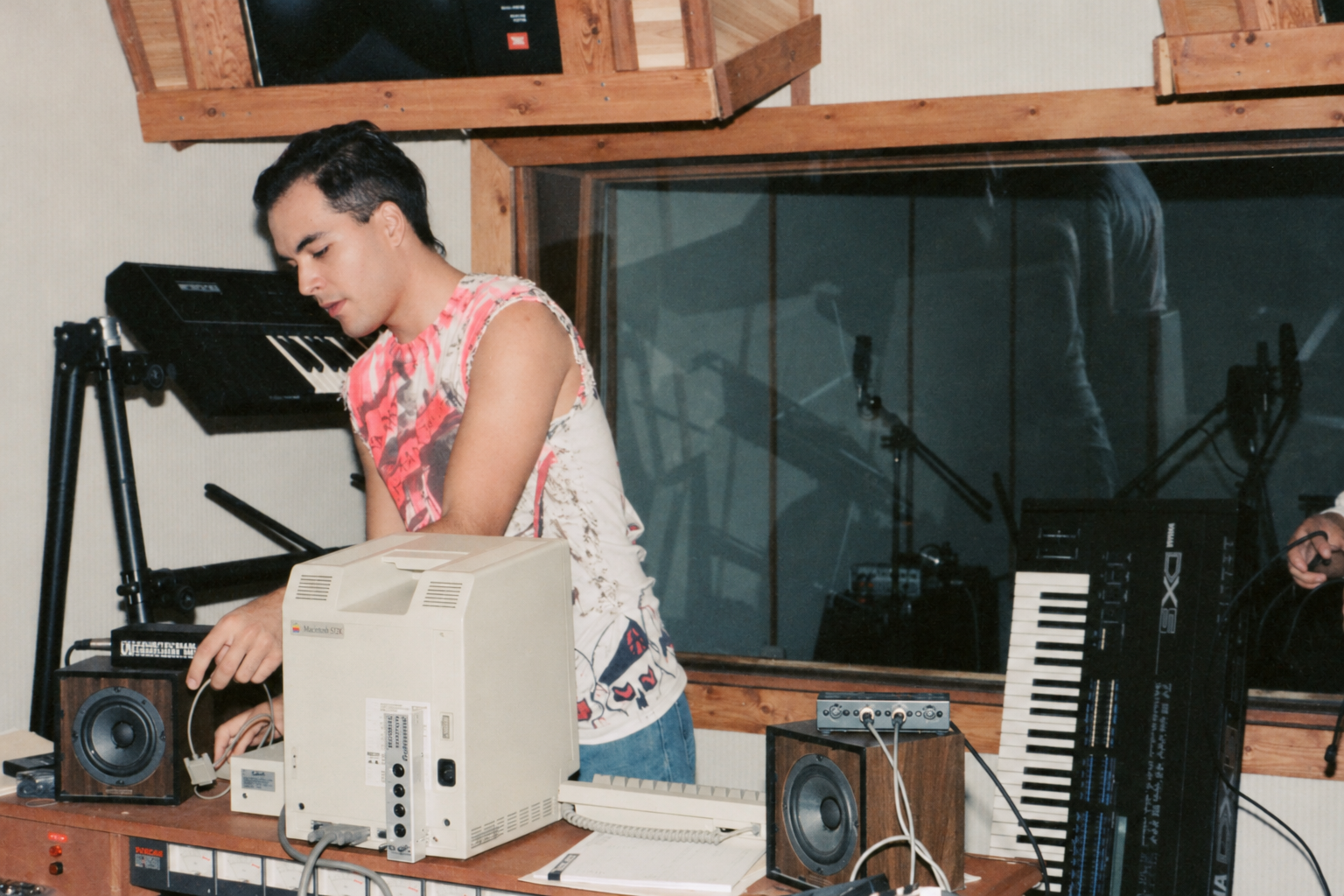
There is a photo of me from around 1986 in a recording studio, twenty-one years old, surrounded by keyboards with that Mac sitting prominently in front of me.
At the time, I didn’t know where any of this was going. I was just curious.
Then my first child was born in 1990, and curiosity became something more practical. I needed a more predictable way to make a living.
I got an opportunity to work in a software store that sold music software, mostly sequencers and notation programs.
I decided I needed to learn how to play computers.
So I got serious about it. I gathered the Inside Macintosh documentation I could get my hands on and taught myself.
Eventually I programmed a game. That game became my resume. I sent it to Broderbund Software and ended up working there as a sound designer on products including Where in the World Is Carmen Sandiego? and Kid Pix.
At the time, I thought I had changed careers.
Looking back, I’m not sure I did.
I just found another instrument.
That is part of what makes this moment in AI feel strangely familiar.
There was a time when recording a song required access to expensive studios and equipment. Then home studios collapsed the cost of experimentation. Musicians could go from an idea to something another human could actually hear without first convincing somebody to fund the attempt.
Software has crossed a similar threshold.
A product idea once needed scarce engineering capacity before anyone could really experience it. Today, with the right AI tools, someone can walk into a brainstorming meeting with a working prototype instead of a slide explaining what they hope to build.
AI has given everyone a home studio for software.
But access to the studio doesn’t make you a producer.
Access to an instrument doesn’t make you a musician.
And access to an AI agent doesn’t mean anyone will want the thing you ask it to build.
This is where the lessons from the band become useful again.
A good band is not five people demonstrating their individual capabilities. The rhythm section creates something everyone else can build upon. Other players add structure, texture and melody. Someone carries the story to the audience.
A software team is obviously not a five-piece rock band, but the responsibilities rhyme.
What AI is changing is who can play which part.
A product manager can now build a prototype. A marketer can create functioning software. A developer can explore an interface without waiting for someone else to produce it. Someone who has never written code can direct agents well enough to create something surprisingly sophisticated.
The boundaries are getting blurry.
That makes casting more important, not less.
When I put a band together, I never asked who the most talented musician was and then assigned that person every part. I wanted the right player in the right role.
The same applies to AI.
Sometimes you need the equivalent of a session musician who can handle something incredibly difficult. Sometimes you need a part played exactly the same way every night. Sometimes the simplest tool is the correct one. Sometimes a role that once required a person no longer does. And sometimes what sounds like a performance problem is actually a casting problem.
The question isn’t simply, “How intelligent is this model?”
The better question is, “Is this the right performer for this part?”
And before you can answer that, somebody still needs to know what the whole thing is supposed to sound like.
That is why I think the producer’s role has become so interesting.
AI now allows almost anyone to sit in the producer’s chair.
That doesn’t make everyone Rick Rubin.
The ability to direct creation is not the same thing as having good taste.
You still need judgment. You need to know when something isn’t working, even when it is technically impressive. You need to know what to leave out. You need enough understanding of the whole product to recognize when one part is hurting everything around it.
And if you know exactly what you want, you should be demanding.
I am.
If an agent repeatedly can’t perform a role where I know what good looks like, I will steer it. I’ll change the instructions. I’ll change the tooling. I’ll cast something else.
If I’m still trying to understand the problem myself, I’m much more forgiving.
That isn’t very different from working with musicians.
Does the role fit the larger group?
Does the person, machine or agent performing it understand what is expected?
Are they contributing to the outcome or just producing a lot of notes?
Today I still spend a lot of time learning new instruments. Models, agents, harnesses and tools seem to change every week.
That part doesn’t bother me much.
I remember when samplers showed up. I remember drum machines. Sequencers. Turntables becoming instruments in their own right.
Each one gave creative people another way to make something that couldn’t have been made quite the same way before.
AI feels like that to me.
I know directionally what I want to explore, and I relentlessly steer toward it. Even writing this article has involved some of that same process.
And there are advantages.
With AI, I get some of the creative partnership without discovering halfway across the country that my collaborator is a terrible roommate.
But the machines haven’t made the old lessons irrelevant.
If anything, they have made them easier to see.
Technical ability alone was never enough.
The number of notes was never the point.
Not everyone needed to write the song.
Nobody was guaranteed a part.
And just because we could make something didn’t mean anybody would care.
After all these years, I realize I still walk into technology teams listening for many of the same things I listened for in bands.
Is there a groove?
Are people listening to one another?
Does everyone understand the song?
Is somebody playing over everyone else?
Do people know when to play and when not to?
Do they trust the people around them enough to do their best work?
Does somebody know what done sounds like?
I’ve written before about asking a much simpler question when judging a customer experience: are they dancing?
Maybe that’s the question that survived every instrument I’ve learned to play.
Because whether it was a nightclub in Waikiki, a piece of software, or something built with a team of AI agents, the work was never really finished when we could play the song.
It was finished when somebody wanted to dance.

