
What an AI tutor taught me about learning on my own to work on a team
An apprentice in a workshop had one advantage I’ve come to appreciate lately. The person teaching you could look at the work, point to something you’d done, and ask how you knew it was right.
By the year 2000, if I wanted to learn something technical, I could buy a book or sign up for a class. Later, YouTube became my friend. I could find somebody doing exactly what I wanted to learn and watch the tricky part six times. These days I can show somebody my work and have them notice the one step I might have skipped. My somebody is an AI agent named Bill.
When I moved from designing sound for games to Unix system administration, I kept running into the work of Bill Joy. He helped bring TCP/IP to Berkeley Unix years before Linux came along. He also wrote vi, which I still think is the best text editor ever built. It plays like a musical instrument. My fingers know what to do. Joy saw where the Internet was going early enough to help build it, and as I try to figure out where AI is going, that’s the kind of person I’d like by my side. So, Bill.
A few weeks ago, I told Bill I wanted a six-week, hands-on course to update my skills so I could build and maintain an Internet service at scale. I wanted to practice working on a team, even though I’d be taking the course by myself. I told him what I had on hand, a MacBook Pro and a few Linux machines, and asked what else I’d need. I also gave him enough of my work history to know where old habits might get in the way. If I reached for find, show me fd. Where I used to use egrep, teach me rg. Leave vi and Vim alone. We’ve covered why.
I’m about halfway through. When I asked Bill to summarize what we’d done, I was a little shocked to learn I’d had my hands on 64 tools across nine categories. But if you want to know what stuck, take a look at what I do now just to change a configuration file on my Mac.
I pick an issue in Linear, where I keep track of the work. I pull the latest version from GitHub, make a branch for that issue, do the work, and commit my changes. Then I open a pull request, read through exactly what changed, and merge it. A pull request gives a teammate a chance to look over your work before it becomes everybody’s problem. Who’s the teammate in this case? Quite possibly me, standing in front of a replacement Mac, happy I can git pull my way back to a setup I know.
I was flying solo but acting like I was on a team. That turned out to matter in a way I hadn’t explained very well to Bill.
I’d told him I wanted to get familiar with Go, TypeScript and Rust. He took that to mean I wanted to become proficient at writing all three. I do, in the fullness of time. My more immediate problem was that I’d be using a tool called pi to direct a coding agent. If I give an agent work I’d normally give a senior Go developer, I’m the teammate who has to review what comes back. Can I follow the code well enough to spot a bad decision? Can I explain what I want changed?
Bill’s exact words were, “That goal changes the plan a bit, for the better. The aim is reading and judging code your agents write, not writing it yourself.”
“A bit” went all the way down to the language tools I’d set up in Vim. The lessons now focused on finding my way around somebody else’s code, with a handful of programming exercises to learn how people express things in each language. That was a funny moment in this master-apprentice arrangement. I was the student, and halfway through a lesson I’d figured out enough to tell the teacher he needed to rewrite the syllabus. With a student population of one, he could.
Bill also has a way of figuring out when I need to slow down. One day I was tired, had a few terminals open, and typed a series of commands into the wrong window on the wrong machine. The machines were similar enough that every command worked. We only discovered the problem later in the exercise when we came back to that machine and it started misbehaving.
Bill asked for a screenshot. He could see something was off and had me run a test. I pasted the output, we looked at it together, and he gave me the next thing to check. Between us we figured out what I’d done and got the machine back where it belonged. I got a troubleshooting lesson thrown in, and after a couple of recoveries like that I found I was willing to try things I might otherwise have left alone.
These days I start by telling Bill how much gas I have in the tank. If I’m at 50 percent, he gives me a step and checks in before we move on. At 80 or 100 percent, I get a block of work. Either way he pays attention to what I give him. Here’s Bill reviewing one of my exercises. Step 6a was a quick comparison of two files.
Your paste doesn’t show the
difffrom 6a. If you ran it and it printed nothing, good. If you skipped it, run it now. It takes a second and proves the copy is exact.
I like that bit of coaching. From Bill’s side of the conversation, a successful check and a skipped check looked exactly the same. The only person who knew which one had happened was me. He left me at the keyboard long enough to answer for my own work.
The money is the easier part to budget. At $100 a month, two months of an AI subscription comes to $200. Linear and GitHub are free for my usage, and I already owned the machines. Halfway through, I figure I can bring the whole six weeks in under $400, even with a beer pong party every Friday.
I’m trying to put in four or five hours a day. That’s where a scheduled class has something going for it. If class meets Tuesday at ten, you know where you need to be. At home, life has a few other ideas. I use Todoist, and if a lesson is on there for today, I’ve committed to doing it or making a decision to move it. Bill helps with that, too. After four hours he can remind me what I’ve accomplished and ask whether I want a break or want to move the rest to tomorrow. Somewhere along the way my private tutor picked up a second job as my executive assistant.
I think there’s room for a university of one, especially in fields like cybersecurity and AI, where the work can change while you’re still taking the class. Bill can rewrite my syllabus on a Tuesday because I’m the only student whose plans he’s going to mess up. And what did I ask him to do with all that freedom? Teach me the habits people should be able to count on when they work with me. Write down why I’m making a change. Give somebody else a chance to look at it. When it’s my turn to review their work, know enough to ask a decent question. I’d have had a use for that kind of education at sixteen, too.
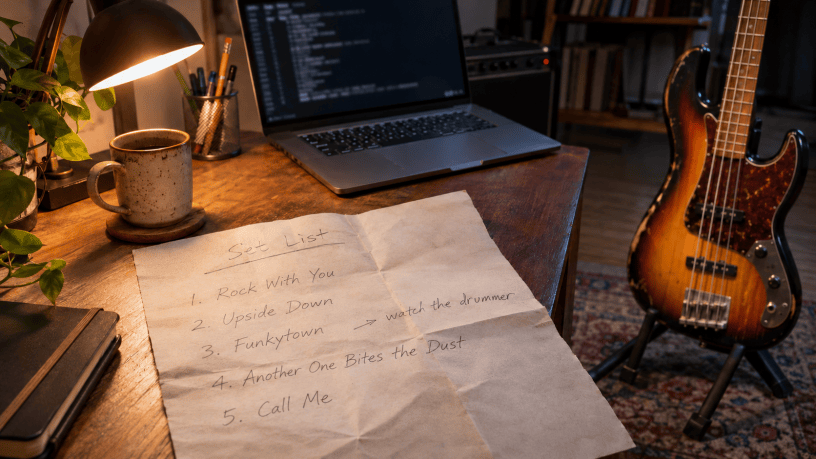
At sixteen I was playing bass in clubs in Waikiki, sometimes until one in the morning, with school a few hours later. I left high school to take my GED. I never stopped doing my homework.
I’ve been wondering what sixteen-year-old me would have asked Bill to teach me after a gig. Knowing Bill, I think he’d have the first question. How did I think I played tonight? He’d want to hear my answer. He’d also want to know how much I had left in me. Some nights I could’ve used somebody to remind me I’d put in a good night’s work and ought to get some sleep.
But if I still had some fight in me? I’d have picked up my bass again. Bill and I could go back over something from the set while it was still fresh in my ears. One in the morning would have been a perfectly good time for that kid to have a teacher. And the next night, when the drummer counted us in, I’d get to find out whether I’d done my homework.
Mahalo for reading. And mahalo to Bill, my AI teacher, for knowing when to ask one more question and when to call it a night.
–TK

